
Are kitchen cabinets made in China good quality?
They can be very good or very poor. The country doesn't decide the quality; the specification does. China exported US$67.8 billion of furniture in 2025, and the UK and Australia are among its five biggest markets, so you'll find every level of quality. Judge a kitchen on its board and emission test, edge banding, hardware and machining, and on who gives you the contract and the warranty.
Why are so many kitchen cabinets made in China?
Because China has the materials, machines and skilled workers in one place. The UK was the second-largest destination for Chinese furniture in 2025 (about 5.1% of exports) and Australia the fourth (about 4.3%), according to the China National Furniture Association.
Clusters such as Foshan in Guangdong put board suppliers, hardware makers, edge-banding and finishing suppliers, and factories within a short drive of each other. Most panel cabinetry there is cut and drilled on CNC machines driven by production software, so dimensional accuracy isn't a matter of luck. For the figures, see Foshan's furniture industry: the facts and figures → /blog/foshan-furniture-industry.
The flip side is range. The same region supplies the cheapest flat-pack and high-end custom joinery, so "made in China" on its own tells you almost nothing.
What actually decides the quality?
Six things, and you can check all of them before you sign.
The board, emissions and edge banding are explained in more detail in Plywood vs particleboard vs MDF → /blog/plywood-vs-particleboard-vs-mdf-cabinets, E0, E1 and ENF formaldehyde grades → /blog/e0-e1-enf-formaldehyde-grades, and PUR, EVA or laser edge banding → /blog/pur-vs-eva-vs-laser-edge-banding.
What actually decides the quality?
| What to check | What good looks like | What to ask for |
|---|---|---|
| Carcass board | Plywood, or a moisture-resistant particleboard or MDF with sealed edges | The board type and thickness, in writing |
| Formaldehyde emissions | A stated class, backed by a test report | Which standard and test method the report uses (see below) |
| Edge banding | PUR or laser-applied edging in the kitchen and bathroom | The edging method and material |
| Hardware | Named hinges and drawer runners from a known maker | The brand and product line of each |
| Machining and finish | Even door gaps, doors that line up, no chipped edges | A finished sample door, or photos of a completed job |
| Contract and warranty | A written quote that says who makes the cabinets, who you contract with and what the warranty covers | The written quote and the warranty terms |
Which Chinese standards apply to kitchen cabinets?
Four are worth knowing. China updated all of them in 2025, and they've all taken effect since November 2025.
In a Chinese standard number, "GB" means national and "QB" means light industry. A "/T" means recommended rather than mandatory.
An important limit. These standards govern products sold in China. Cabinets made for export are built to the buyer's specification and have to meet the rules of the country they're sold in. So the useful question isn't "does it meet Chinese standards?" but "which standard was this tested to, and can I see the report?"
Which Chinese standards apply to kitchen cabinets?
| Standard | What it covers | Status |
|---|---|---|
| GB 18580-2025, formaldehyde limits for wood-based panels and products | From 1 June 2026, boards must meet E1 (≤0.124 mg/m³) and finished wood-based products must meet E0 (≤0.050 mg/m³) | Mandatory (in China) |
| QB/T 2531-2025, *Kitchen furniture* | Appearance, dimensions and tolerances, moisture content, physical, chemical and mechanical performance, safety and installation, with test methods. In effect from 1 February 2026, replacing the 2010 edition | Recommended industry standard |
| GB/T 45545-2025, *Kitchen furniture: coordinating sizes* | Heights, widths and depths of cabinets and worktops, and spaces for appliances. Identical to ISO 3055:2021. In effect from 1 November 2025 | Recommended national standard |
| QB/T 4463-2025, *Edge banding for furniture* | Requirements for edge banding strips. In effect from 1 February 2026, replacing the 2013 edition | Recommended industry standard |
What should you ask before you sign?
Ask these, and get the answers in writing:
- What's the carcass made of, and how thick is it?
- Which formaldehyde class do the boards meet, under which standard and test method? Is there a test report, and does it cover the board or the finished cabinet?
- How are the edges banded, and are hidden edges banded too?
- Which brand and product line are the hinges and drawer runners?
- Who am I signing the contract with, who installs, and who gives the warranty?
- What does the warranty cover, and for how long?
A supplier who's confident in their product will answer all six without hesitating.
Who is responsible if something goes wrong?
Whoever you sign the contract with. For a kitchen booked through Kabinly, that's always your local partner. You sign with them and pay them, and they give the warranty, set out in their written quote. Your local partner can quote Kabinly cabinetry and may also offer cabinetry from their own range. Your written quote says whose cabinetry it is, who you contract with and what the warranty covers.
How are Kabinly cabinets made?
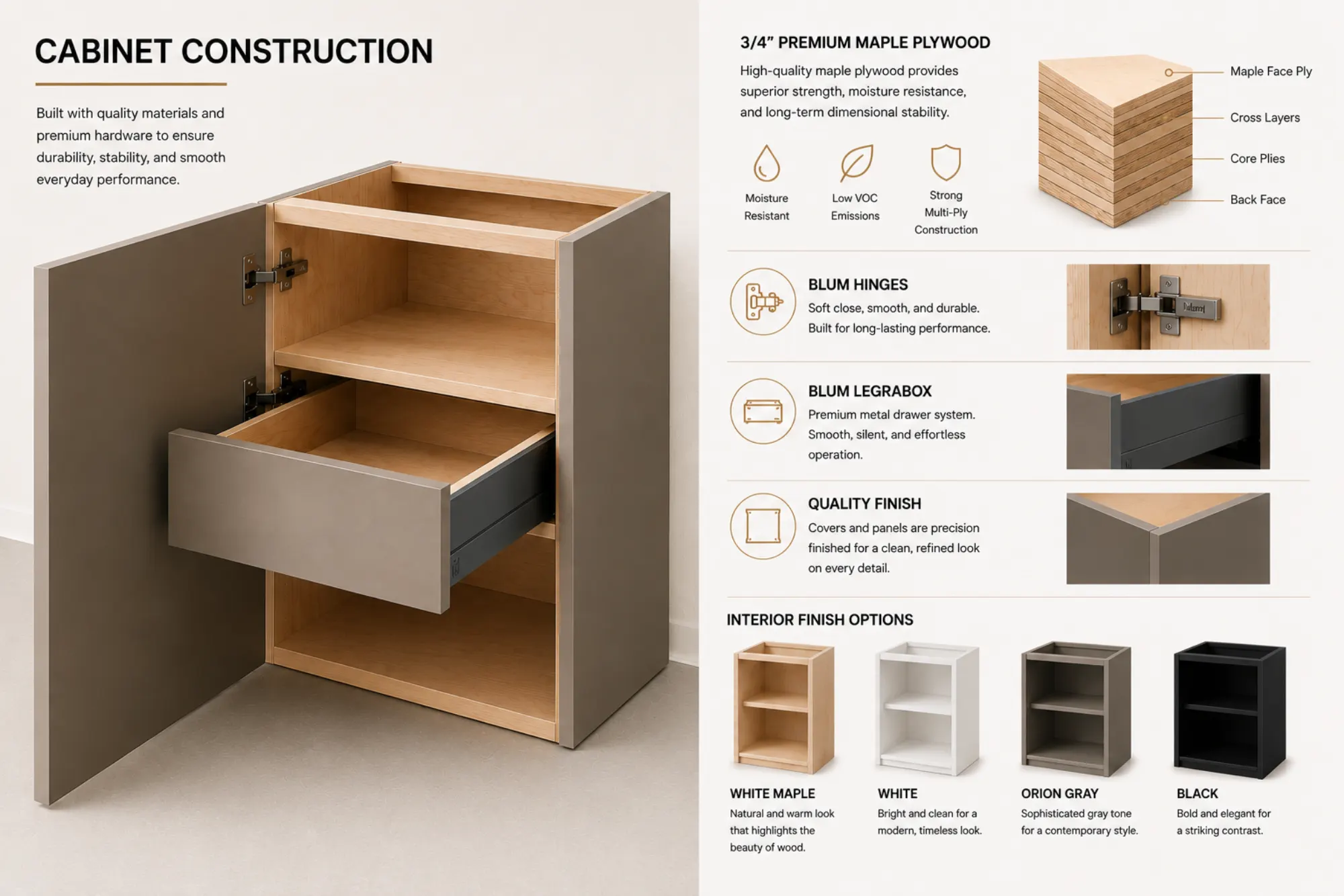
Kabinly cabinetry is made with partner factories in Foshan, China, and we say so plainly. Every Kabinly cabinet has a 3/4-inch maple plywood carcass, Blum CLIP top BLUMOTION soft-close hinges and a Blum LEGRABOX drawer system, with dovetail drawer boxes as an option → /products/kitchen-cabinets. When you choose Kabinly cabinetry, our design team supports your partner with 3D renderings and technical drawings, and we manage production, quality control and shipping to your partner.
To see the steps a panel cabinet goes through, read How custom kitchen cabinets are made → /blog/how-custom-cabinets-are-made.
FAQ
Is "made in China" the same as flat pack?
Do Chinese-made cabinets meet Australian or UK standards?
Is a Chinese national standard a guarantee of quality?
Who gives the warranty on a Kabinly kitchen?
Start with a free measure
A local partner comes to you, measures the space and talks through what you want. No cost, no obligation.
Sources
- 中国家具协会《2025年家具行业进出口报告》 , 2026-03-06. https://www.cnfa.com.cn/messdetail1s59.html · 2025 · https://www.cnfa.com.cn/messdetail1s59.html
- 中国家具协会《2025年中国家具行业经济运行简报》 , 2026-02-12. · 2025 · https://www.cnfa.com.cn/messdetail1s58.html
- GB 18580-2025《室内装饰装修材料 人造板及其制品中甲醛释放限量》 , national standard record. · 2025 · https://std.samr.gov.cn/gb/search/gbDetailed?id=36A29D07E2ACD444E06397BE0A0ACC4C
- 国家林业和草原局《新国标加严人造板制品甲醛限量》 , 2025-07-04. · 2025-07-04 · https://www.forestry.gov.cn/c/www/gglcgy/633233.jhtml
- QB/T 2531-2025《厨房家具》 , industry standard record. · 2025 · https://hbba.sacinfo.org.cn/stdDetail/59f10081b6589fb71b2a2b24e278150ce5ff81468ddaaeb1a7c298778729bf65
- GB/T 45545-2025《厨房家具 配合尺寸》 , national standard record. https://std.samr.gov.cn/gb/search/gbDetailed?id=33D40F1160EE5D92E06397BE0A0A5B93 · 2025 · https://std.samr.gov.cn/gb/search/gbDetailed?id=33D40F1160EE5D92E06397BE0A0A5B93
- QB/T 4463-2025《家具用封边条》 , industry standard record. · 2025 · https://std.samr.gov.cn/hb/search/stdHBDetailed?id=4C52F8EC43F864E0E06397BE0A0A24E3