E0, E1 and ENF: formaldehyde grades for cabinet boards, explained
E0, E1 and ENF are formaldehyde emission classes for wood-based boards such as particleboard, MDF and plywood. Lower is better. Under China's grading standard, measured in a 1 m³ test chamber, E1 is up to 0.124 mg/m³, E0 up to 0.050 mg/m³ and ENF up to 0.025 mg/m³. But Australia's E0 uses a different test and unit, and the EU has its own limit. So always ask which standard a label refers to.
Why is there formaldehyde in cabinet boards at all?
Mostly from the glue. Particleboard, MDF and many plywoods are bonded with resins that can release small amounts of formaldehyde, especially when they're new, warm or humid. Wood itself also gives off traces of formaldehyde naturally, which is why no board can honestly be called "zero".
Emission classes exist so buyers can compare boards on one measure: how much formaldehyde a sample releases under set test conditions.
What do E1, E0 and ENF mean in China?
They're the three grades in China's national grading standard, GB/T 39600-2021, and since 1 June 2026 two of them have been mandatory.
The change matters. The old mandatory standard, GB 18580-2017, set a single limit of 0.124 mg/m³. China's National Forestry and Grassland Administration describes the 2025 revision as the first time E0 has been written into a mandatory national standard, and says finished wood-based products at E1 level are phased out from 1 June 2026. The test method is still the 1 m³ climate chamber, with a shorter test period.
These rules apply to products sold in China. Cabinets made for export are built to the buyer's specification and must meet the rules where they're sold.
What do E1, E0 and ENF mean in China?
| Grade | Limit (1 m³ climate chamber) | Status in China |
|---|---|---|
| E1 | ≤0.124 mg/m³ | The minimum for boards (人造板) under GB 18580-2025 |
| E0 | ≤0.050 mg/m³ | The minimum for finished wood-based products (人造板制品), such as faced panels, wall panels, doors and flooring, under GB 18580-2025. Before June 2026 it was voluntary |
| ENF | ≤0.025 mg/m³ | Voluntary. The lowest grade, first introduced in GB/T 39600-2021 |
Does ENF mean formaldehyde-free?
No. ENF is a limit of 0.025 mg/m³, not zero. Chinese marketing often pairs ENF with "无醛" or "无醛 添加" ("no added formaldehyde"), which describes the glue, not the emission result. A board made with a no-added-formaldehyde glue still releases trace formaldehyde from the wood itself. Ask for the class and the test report, not the slogan.
How do Chinese, Australian and European grades compare?
They use different tests and units, so the same label can mean different things.
Two things stand out:
- The EU limit is for the article, not just the board. From August 2026, a whole piece of furniture sold in the EU or Northern Ireland has to meet 0.062 mg/m³ in the specified test. An E1 board on its own no longer proves compliance.
- "E0" isn't one number. A Chinese E0 is a chamber result in mg/m³. An Australian E0 is a desiccator result in mg/L. Both mean "low", but you can't read one as the other.
How do Chinese, Australian and European grades compare?
| Market | What sets the grade | Test and unit | Key figures |
|---|---|---|---|
| China | GB/T 39600-2021 (grades) and GB 18580-2025 (mandatory limits) | 1 m³ climate chamber, mg/m³ | E1 ≤0.124 · E0 ≤0.050 · ENF ≤0.025 |
| Australia and New Zealand | AS/NZS 1859 board standards | Desiccator method (AS/NZS 4266.16), mg/L | E0 ≤0.5 mg/L, as published in board makers' certificates. "Super E0" is an industry class: ≤0.3 mg/L on average, ≤0.4 mg/L maximum |
| EU and Northern Ireland | REACH Annex XVII, entry 77 (Regulation (EU) 2023/1464) | Chamber test under set conditions, mg/m³ | From 6 August 2026, furniture and wood-based articles may not release more than 0.062 mg/m³ |
| Great Britain | UK REACH | — | The UK's Health and Safety Executive has assessed formaldehyde in articles. At the time of writing we haven't found a GB restriction in force. Check HSE for updates |
Can you convert mg/L to mg/m³?
Not reliably. The chamber test measures the air in a room-like box over days. The desiccator test measures what a small sample gives off into water in a sealed jar over one day. The two tests use different samples, temperatures and times, so there's no fixed conversion factor. Be wary of any table that claims one.
Does the board grade decide the air in your kitchen?
It's the biggest factor you can choose, but not the only one. The air in a room also depends on:
- How much board there is. A kitchen and a wall of wardrobes add up to a lot of surface area.
- Sealed edges. Edge banding covers the cut edges, where the core is exposed.
- Ventilation. Fresh air brings levels down, especially in the first weeks.
- Heat and humidity. Warm, damp air increases emissions.
- Other sources. Paints, flooring, furniture, gas cooking and smoking all contribute.
For reference, China's indoor air quality standard, GB/T 18883-2022, sets a guide level of 0.08 mg/m³ for formaldehyde in room air (one-hour average). That's a limit for the room, not for a board, so it doesn't tell you what any one cabinet releases.
What should you ask a supplier?
Get these in writing:
- Which emission class do the boards meet?
- Under which standard and test method (chamber or desiccator)?
- Is there a test report? From which lab, how recent, and for which product?
- Does the report cover the bare board or the finished cabinet?
- Are all cut edges banded, including the hidden ones?
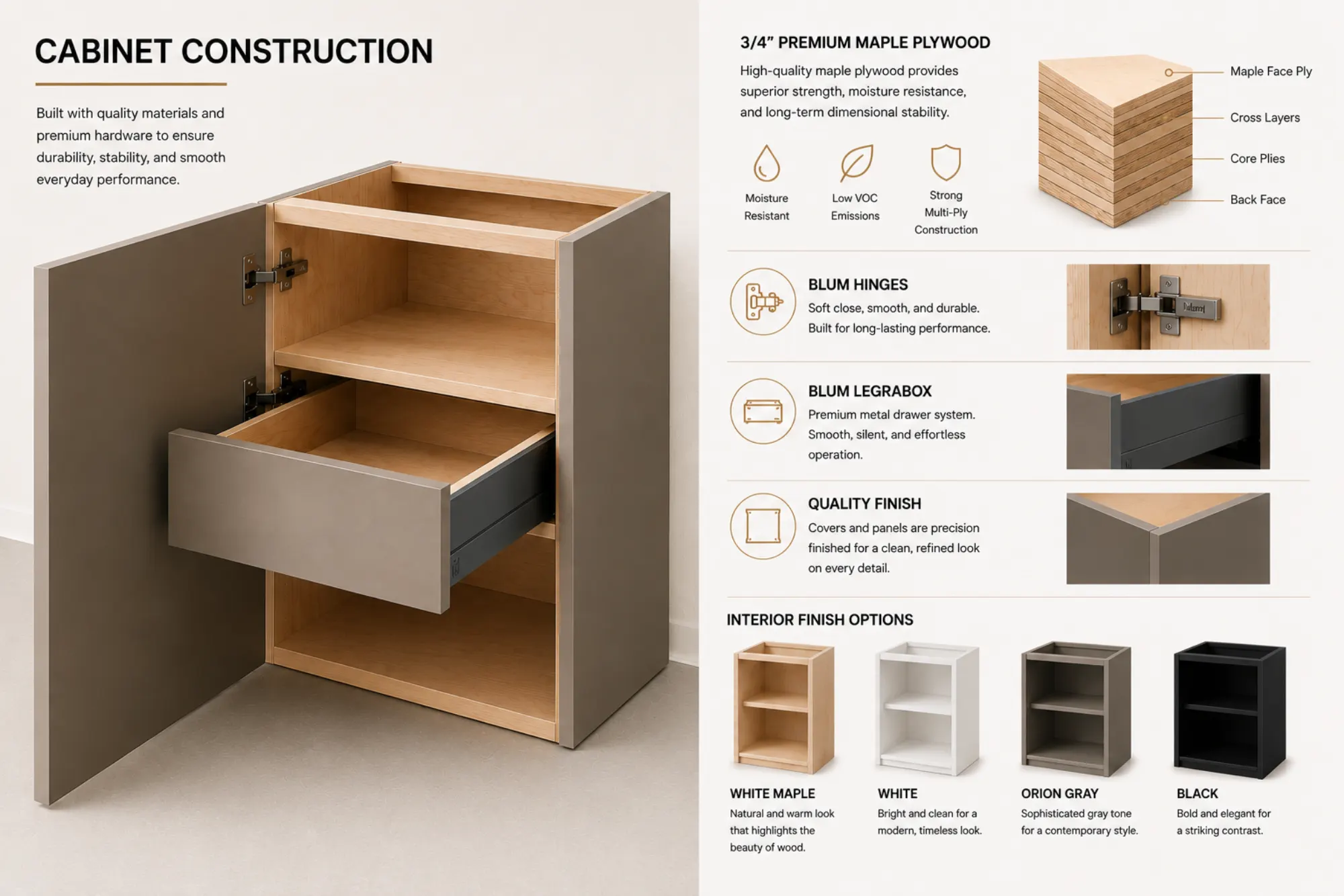
That applies to any cabinetry, whoever makes it. For a kitchen booked through Kabinly, ask your local partner at your free measure → Book a free measure. The boards themselves are compared in Plywood vs particleboard vs MDF → /blog/plywood-vs-particleboard-vs-mdf-cabinets, and our construction is on /products/hardware-drawer-systems/cabinet-construction.
FAQ
Is E0 safe?
Is plywood lower in formaldehyde than particleboard?
What is Super E0?
Does the new EU limit apply in the UK?
Start with a free measure
A local partner comes to you, measures the space and talks through what you want. No cost, no obligation.
Sources
- GB/T 39600-2021《人造板及其制品甲醛释放量分级》 , national standard record. · 2021 · https://std.samr.gov.cn/gb/search/gbDetailed?id=BD89DE8E074A3D08E05397BE0A0A4FAD
- GB 18580-2025《室内装饰装修材料 人造板及其制品中甲醛释放限量》 , national standard record. · 2025 · https://std.samr.gov.cn/gb/search/gbDetailed?id=36A29D07E2ACD444E06397BE0A0ACC4C
- 国家林业和草原局《新国标加严人造板制品甲醛限量》 , 2025-07-04. · 2025-07-04 · https://www.forestry.gov.cn/c/www/gglcgy/633233.jhtml
- GB/T 18883-2022《室内空气质量标准》 , national standard record. · 2022 · https://std.samr.gov.cn/gb/search/gbDetailed?id=E3C42FB7AC9F2086E05397BE0A0A19F0
- Commission Regulation 2023/1464 of 14 July 2023 , EUR-Lex. https://eur-lex.europa.eu/legal-content/EN/TXT/PDF/?uri=CELEX%3A32023R1464 · 2023 · https://eur-lex.europa.eu/legal-content/EN/TXT/PDF/?uri=CELEX%3A32023R1464
- Defra, *Explanatory memorandum on Commission Regulation 2023/1464* , GOV.UK. · 2023 · https://assets.publishing.service.gov.uk/media/65a051aa3308d200131fbec3/EM_C_2023_4687_FINAL_+_ANNEX.pdf
- Health and Safety Executive, *UK REACH: RMOA for formaldehyde and formaldehyde releasers*. · https://consultations.hse.gov.uk/crd-reach/formaldehyde-releasers-rmoa-010
- EWPAA, *Formaldehyde emission classifications* certificate for Borg Panels , published by polytec. · https://www.polytec.com.au/docs/environment/polytec-technical-formaldehyde-emission-classifications.pdf
- Salem, M. Z. M. and Böhm, M., *Understanding of formaldehyde emissions from solid wood: an overview*, BioResources . · 2013 · https://www.researchgate.net/publication/259182955_Understanding_of_Formaldehyde_Emissions_from_Solid_Wood_An_Overview