
How custom kitchen cabinets are made: the factory process, step by step
Most custom kitchen cabinets are made from flat panels in a software-driven factory. The design is broken down into a list of parts, CNC machines cut each part from full sheets, the cut edges are banded, holes for hinges and fixings are drilled from a barcode, and the parts are checked, sorted by order and packed. Doors and finishes follow a parallel line. The precision comes from the drawings as much as the machines.
What happens to the design first?
It's turned into a list of parts, which Chinese factories call 拆单 (chāi dān, "breaking down the order"). Every cabinet in your drawings becomes a set of panels: sides, base, top rails, shelves, back and doors. Each part gets exact dimensions, the edges to be banded, and the position of every hole.
This step decides almost everything that follows. A wrong measurement or a missed clash with an appliance gets built exactly as drawn. That's why the measure and the approved drawings matter so much: the factory can only make what the drawings say.
Large manufacturers now do this in software. Shangpin Home Collection, a listed Chinese custom-furniture company whose production subsidiaries include Foshan Weishang, describes automated order checking, order breakdown and production scheduling, with every part tracked by QR code, in its 2025 half-year report.
How are the panels cut?
On CNC machines, from full sheets. Software "nests" the parts from many orders onto each sheet to waste as little board as possible. A common sheet size is 2440 × 1220 mm. The machine, usually an electronic panel saw or a CNC nesting router, cuts every part to size and can also rout the grooves for back panels.
Each part is labelled with a barcode or QR code as it comes off the machine. From here on, that label tells every machine and every worker what the part is and which order it belongs to.
What is edge banding, and when is it done?
Straight after cutting. Every visible cut edge is covered with a strip of edging (usually PVC, ABS or a matching veneer). An automatic edge bander does it in one pass:
- Pre-milling trims a fraction off the edge so it's clean and square.
- Gluing and pressing applies the adhesive (EVA, PUR or, for laser edging, a fused layer) and presses the strip on.
- End trimming cuts the strip flush at each end.
- Trimming, scraping and buffing take the strip flush with both faces and round off the edge.
The adhesive matters more than most people realise, especially around sinks and dishwashers. See PUR, EVA or laser edge banding → /blog/pur-vs-eva-vs-laser-edge-banding.
How are the holes drilled?
By CNC boring machines that read the part's barcode. Scanning the label loads that part's drilling program: hinge cups on the doors, holes for shelf pins, holes for the fixings that join the cabinet together, and mounting points for drawer runners. Six-sided drilling machines can drill all faces of a panel without it being turned by hand.
Accuracy here shows up at assembly. If holes are out by even a fraction of a millimetre, doors don't line up and drawers don't run true. This is one of the main reasons software-driven panel factories produce consistent results.
How are doors and finishes made?
On a separate line, because they need different processes. The route depends on the finish:
Not every factory does every step in-house. Shangpin's report, for example, says some of its boards are bought plain and sent to other firms to be surfaced before production.
How are doors and finishes made?
| Door type | Usual process |
|---|---|
| Laminate or melamine | The decorative surface is pressed onto the board, often before cutting |
| Timber veneer | Veneer is pressed onto an MDF or plywood core, then sanded and lacquered |
| Painted (Shaker, profiled) | MDF is routed to shape, then primed, sanded and painted in several coats |
| Frame-and-panel | The frame and panel are made separately, then glued up, sanded and finished |
How are the parts checked and packed?
Parts are checked, sorted by order and packed flat. After machining, parts are inspected for size, edge quality and surface damage. Sorting is driven by the barcodes. Shangpin's founder, Li Lianzhu, has compared it to 抓中药, a traditional Chinese pharmacy filling a prescription: every part for one order is collected from numbered racks and packed together. Packs are labelled by cabinet so they can be assembled in the right place on site.
Cabinets are then shipped either flat, for assembly on site, or assembled, depending on the product and the order.
The process at a glance
| Step | What happens | What goes wrong if it's done badly | What you can check |
|---|---|---|---|
| Drawings and order breakdown | The design becomes a parts list | Wrong sizes, appliance clashes | Approve detailed drawings before production |
| CNC cutting | Parts cut from full sheets | Chipped faces, parts out of square | Clean, sharp edges on a sample door |
| Edge banding | Cut edges covered | Visible glue line, lifting edges, water getting in | The edging method and material |
| CNC drilling | Holes for hinges and fixings | Doors that don't line up, loose fixings | Even door gaps on a finished job |
| Doors and finishes | Surfaced, veneered or painted | Uneven paint, peeling surfaces | A finished sample in the chosen finish |
| Checking and packing | Parts checked, sorted, packed | Missing or damaged parts | Delivery checked against the packing list |
What does this mean for your kitchen?
Two things. The measure and the drawings are where you have the most influence, and the specification decides how long the kitchen lasts.
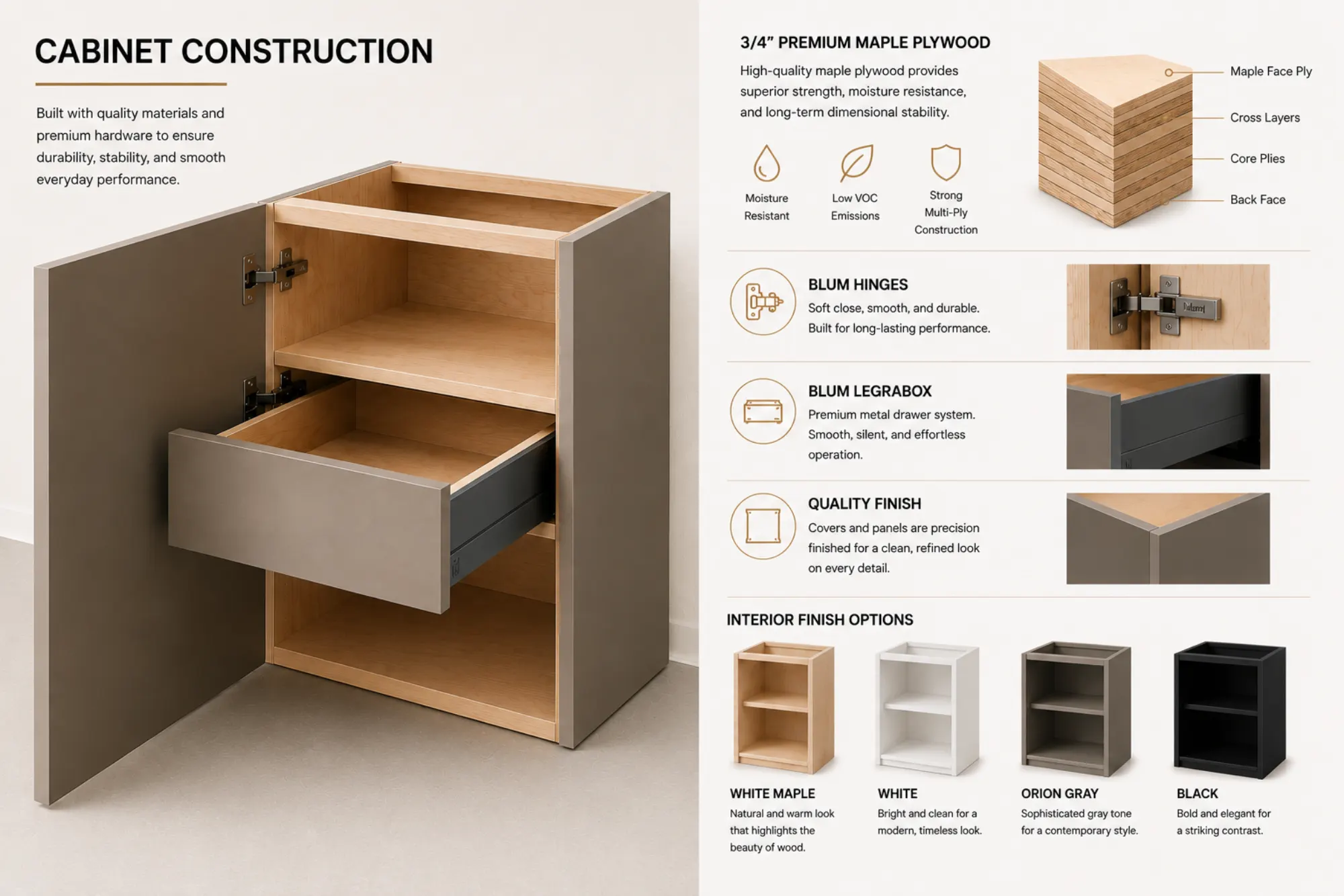
With Kabinly, your local partner measures for free → Book a free measure. When you choose Kabinly cabinetry, our design team supports your partner with 3D renderings and technical drawings, and we manage production with partner factories in Foshan, quality control and shipping to your partner. Every Kabinly cabinet is built on a 3/4-inch maple plywood carcass with Blum hardware → /products/hardware-drawer-systems/cabinet-construction.
FAQ
Are custom cabinets made by hand?
Why does it matter that holes are drilled by CNC?
Are cabinets delivered assembled or flat?
Does this process work for plywood as well as particleboard?
Start with a free measure
A local partner comes to you, measures the space and talks through what you want. No cost, no obligation.
Sources
- 广州尚品宅配家居股份有限公司《2025年半年度报告》 , Shenzhen Stock Exchange filing, 2025-08-27. Production model and purchasing model . · 2025 · https://disc.static.szse.cn/disc/disk03/finalpage/2025-08-27/4dd89df7-94f9-4ff5-ba34-bd2a4093f43c.PDF
- 创业邦《尚品宅配如何定制家居》 : barcode-driven edge banding and drilling, and the "filling a prescription" sorting step. · https://magazine.cyzone.cn/article/197743.html
- QB/T 4463-2025《家具用封边条》 , industry standard record. · 2025 · https://std.samr.gov.cn/hb/search/stdHBDetailed?id=4C52F8EC43F864E0E06397BE0A0A24E3