
Plywood vs particleboard vs MDF: which is best for kitchen cabinets?
For the cabinet box (the carcass), plywood is the strongest and most moisture-tolerant of the three, and it holds screws and hinges best. Particleboard is the cheapest and most common, especially in flat-pack kitchens, but it swells if water gets in. MDF is the smoothest, which makes it ideal for painted doors, but it's heavy and not the best choice for a carcass under a sink.
The three boards at a glance
| Plywood | Particleboard (chipboard) | MDF | |
|---|---|---|---|
| Made from | Thin timber veneers glued in cross-grain layers | Wood chips and particles bonded with resin | Fine wood fibres bonded with resin |
| Strength for weight | Highest | Lowest | Medium, but heavy |
| Screw and hinge holding | Best, holds repeated adjustment | Weakest. Holes can strip | Good face holding, weak edges |
| If water gets in | Most tolerant (not waterproof) | Swells and crumbles at edges | Swells unless moisture-resistant grade |
| Surface | Timber face, edges show layers | Needs a laminate or melamine face | Very smooth, machines and paints well |
| Typical use | Premium carcasses, shelves | Budget and flat-pack carcasses | Painted and profiled doors, panels |
| Relative cost | Highest | Lowest | Middle |
What's the difference, really?
Plywood is made from thin sheets of timber veneer, each laid at right angles to the one below and glued under pressure. The cross-grain layers are why it's strong and why it resists warping. Each layer braces the next.
Particleboard, called chipboard in the UK, is made from wood chips and sawdust pressed with resin. It's flat, stable and cheap, which is why most flat-pack kitchens use it. In Australia, kitchens often use HMR (high moisture resistant) particleboard, which copes better with damp than standard board.
MDF (medium-density fibreboard) is made from wood broken down to fibres, then pressed with resin into a dense, smooth sheet. There's no grain, so it can be routed into profiles and painted to a flawless finish. That's why so many painted Shaker and profiled doors are MDF.
Which is best for the cabinet box?
The carcass carries the weight of the benchtop (worktop in the UK), holds every hinge and drawer runner, and sits next to the dishwasher and sink. It's where the board choice matters most.
- Plywood is the best all-rounder. It holds hinge screws through years of adjustment and tolerates the occasional leak better than the alternatives.
- HMR particleboard is a reasonable budget choice if the edges are well sealed.
- MDF is rarely used for carcasses. It's heavy, and its edges are weak for screws.
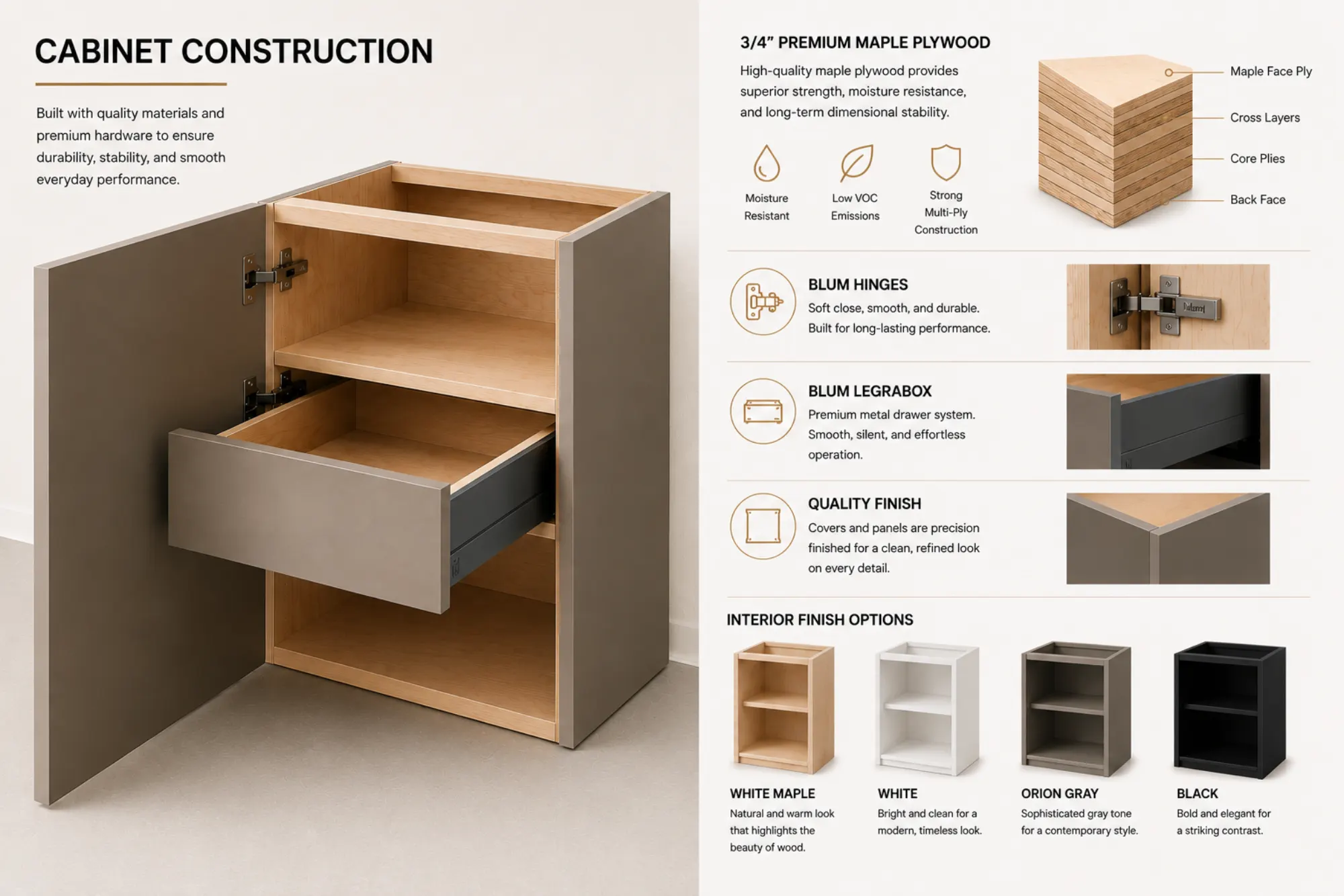
Every Kabinly cabinet uses a 3/4-inch maple plywood carcass, with Blum soft-close hinges and drawer runners. → /products/hardware-drawer-systems/cabinet-construction
Which is best for doors?
| Door finish | Usual core |
|---|---|
| Painted (Shaker, profiled) | MDF: smooth and easy to machine |
| Laminate / melamine surface | Particleboard or MDF |
| Timber veneer | MDF or plywood |
What about moisture?
No board is waterproof. The real protection is:
- Sealed edges. Edge banding on every cut edge, especially around the sink. PUR or laser edging copes best with water → /blog/pur-vs-eva-vs-laser-edge-banding.
- Ventilation. Leave the dishwasher door ajar after hot cycles and use the rangehood.
- Leak prevention. Check the tap and dishwasher connections. A slow leak under the sink ruins any board over time.
Plywood simply gives you more margin if something goes wrong.
What about emissions
Most boards are made with resins that can release small amounts of formaldehyde. Standards set the limits:
- Australia: boards are rated E0 or E1 under AS/NZS standards. E0 is the lower-emission class.
- EU and Northern Ireland: from 6 August 2026, furniture may not release more than 0.062 mg/m³ in the test set by EU REACH. Great Britain has its own UK REACH rules.
- China: since 1 June 2026, finished wood-based products sold in China must meet E0.
The labels don't mean the same thing everywhere. See E0, E1 and ENF formaldehyde grades → /blog/e0-e1-enf-formaldehyde-grades.
Ask any supplier which class their boards meet, and get the answer in writing.
So which should you choose?
- Choose plywood carcasses if you want the kitchen to last, especially under sinks and in humid climates.
- Choose MDF doors if you want a painted or profiled finish.
- Accept particleboard if budget comes first, but insist on moisture-resistant board and sealed edges.
FAQ
Is plywood worth the extra cost?
Is MDF toxic?
What is HMR board?
Are flat-pack kitchens always particleboard?
Start with a free measure
A local partner comes to you, measures the space and talks through what you want. No cost, no obligation.